Uncertainty surrounds rehabilitation of the 347 kilometres (km) section of the M1 as contractors and government are in a stand-off over the currency to pay for the works.
While government said yesterday it has money to pay contractors whose certificates were approved within the past six months provided the firms accept Malawi kwacha equivalents, the companies, on the other hand, want the funds remitted in euros or else they will halt works.
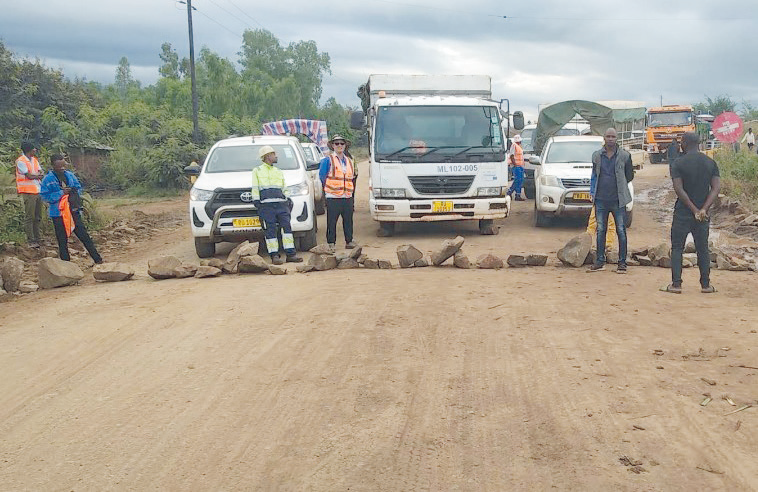
The M1 project, worth €191million (about K410 billion at the current official exchange rate), stretches from Kamuzu International Airport turnoff in Lilongwe to Chiweta in Rumphi.
It was divided into four lots assigned to different contractors who are now finding it difficult to carry works due to non-payment.
Contractors are China Jiangxi for Lot 1 (from Kamuzu International Airport (KIA) Junction to Kasungu Boma), Mota-Engil Malawi for Lot 2 (from Kasungu Boma to Jenda), Unik Construction Engineering Limited for Lot 3 (from Jenda to Mzimba Turn Off and China Henan International Corporation Group Company Limited for Lot 4 (from Kacheche to Chiweta).
Loose minutes we have seen captured by an attendee from one of the contractors show that two meetings were held on January 30 2026 at Roads Authority (RA) and February 2 2026 at the Reserve Bank of Malawi (RBM) offices.
The January 30 meeting, according to the minutes, was chaired by RA and attended by representatives from Roads Fund Administration (RFA), RBM, Ministry of Finance and the four contractors.
The minutes read in part: “At such meetings, it was requested that a portion of the outstanding certificate of payment and future payments of the contract is to be paid in Malawi kwacha.
“This request is in conflict with the provision of sub-clause 14.7.2 [Payment Currency] of the GCC [General Conditions of Contract], which forms part of the Basis of the Contract Accepted between the Parties and executed between the Parties thereof.”
The document says the currency of payment as agreed among the Government of Malawi, the European Union / European Investment Bank and the Contractor was euro.
“For the avoidance of doubt, we reiterate that any request for payment of any portion of the IPCs in local currency has not been accepted, as it is inconsistent with the contractual provisions and all payments due to the contractor are to be made in the currency of euro,” it adds.
On Tuesday, it was discovered that contractor for Lot 1, China Jiangxi International, was last paid in June 2025 and has since suspended works in protest of non-payment.
Contractor for Lot 2, Mota Engil was last paid in October 2025 and has given government up to February 13 to pay, failing which it will also suspend works, while contractors for Lots 3 and 4 have also given notices.
In an interview, consultant for Mota Engil, Pythias Mpofu confirmed that non-payment of certificates is threatening the project, adding that the company is owed €1.3 million (around K2.8 billion) in unpaid certificates since October last year.
“Contractually, what happens is that when there is non-payment, the contractor is within the contractual right to suspend works,” he said.
Mpofu added that delays in paying also attract interests, which will have to be paid by government of Malawi.
For Lot 4, documentation sourced, shows that as of yesterday, the contractor, China Henan International Corporation Group Company Limited is owed 2.8 million euros (roughly K6 billion).
“We have already incurred huge losses and are under immense financial pressure. We are working hard to expedite construction, but IPC [Interim Payment Certificate] totalling approximately 2.8 million euros from last year are already two months overdue.
“If the delays continue, the normal operation and construction of the project will face serious risks,” reads the document presented to the Ministry of Transport and Public Works.
Minister of Finance, Economic Planning and Decentralisation Joseph Mwanamvekha admitted in an interview yesterday that contractors are insisting on getting foreign currency.
“We had a meeting and contractors are insisting on getting foreign currency, but if they wanted in kwacha, all of them can be paid today! We told them to talk to RBM through the RA and RFA to meet the contractors on their demand.
“It’s not a question of money, no, money is available and remember this one is off the budget, but what they are demanding is the issue,” he said.
Minister of Transport and Public Works Jappie Mhango said progress on M1 is a mixed bag with contractors threatening suspension of works on account of non-payment dating back to six months ago.
The European Union alongside European Investment Bank are the major financiers of the project through both a grant and a loan.
Mhango said in a written response: “The financiers provided all the funds, but as to what has happened, Ministry of Finance would be better placed to comment.”
When civil society led Black Economic Empowerment Movement (Mablem) toured the works on Tuesday, RA senior public relations officer Alice Chinthochi said they are working with government to ensure that the contractors are paid so that works are not affected.
Mablem chairperson Robert Mkwezalamba said delays will also see government paying more as there are interests charged.
“Our immediate call to government is to demand that they honour their obligation. It is rainy season, we are still going to face many challenges that need contractors to be on the ground to address them,” he said.
Snaking roughly through 1 140 kilometres from the Tanzanian border in the North to the Mozambican border in the South, the M1 is the country’s primary north-south transport backbone, serving as the main artery for trade, agricultural logistics and regional connectivity. The current rehabilitation and upgrading efforts are meant to turn the route into a durable and safe corridor that can help bring efficiency gains to the national economy.
Former president Lazarus Chakwera launched rehabilitation of the M1 in July 2022. However, the project did not start for about a year due to various challenges, including changes in design.